SpaceFind journal
The space is already here
By SpaceFind Editorial
We talk about space as though it only becomes useful when it is built, sold or leased. But all around us, useful space already exists. The harder problem is knowing when it is empty, where to find it and how to get through the door.
At nine in the morning, a meeting room can sit empty while someone nearby takes a call from their car.
By afternoon, a studio can be quiet between classes while a photographer searches for somewhere to work. Across the city, a secure room can go unused while a small business runs out of space for its stock.
None of these spaces is vacant in the conventional sense. None is automatically available. Some will not be suitable for another use at all. But together they reveal something important: a city can be full of space and still make useful space remarkably hard to find.
We call this a shortage because that is what it feels like to the person looking. Often, however, part of the shortage is really an access problem.
We organise property. People organise their lives.
The property market is built around recognisable categories: offices, venues and warehouses. These labels tell us what a property is. But people rarely begin there.
They begin with a need.
Perhaps they need somewhere for six people every Tuesday, without taking on a permanent office.
The difference matters. When needs are forced into property categories too early, useful possibilities disappear from view. A space can suit an activity without being advertised for it, and it can be regularly available without being permanently “to let”. What matters is not only what the space is called, but what it can make possible—and on what terms.
The space exists. The connection does not.
Empty and occupied are not the only two states
Property is usually presented as a binary choice: it is available or it is not. Real life is more complicated.
A space can be occupied but available at particular times. It can be available for one-off use but not a tenancy. It can accept enquiries but not instant bookings. It can support a recurring arrangement, a membership, a short licence or a longer commercial agreement. It can be useful to one person and completely wrong for another.
This is why simply publishing a list of empty buildings will never solve the whole problem. Access has conditions: time, purpose, price, capacity, security, noise, equipment, insurance, planning, neighbours and the owner's own operation.
Those conditions are not administrative clutter. They are what turn an interesting room into a space somebody can responsibly use.
Bristol already understands activation
The idea of putting existing space to better use is not speculative. Bristol's published Local Plan supports suitable temporary uses of vacant buildings and sites where they contribute to economic or community activity. It describes creative, cultural, leisure and flexible-workspace uses that can bring activity to a place while it awaits a longer-term future.
That principle is usually called meanwhile use. It is valuable, but it deals mainly with a particular condition: space standing vacant between permanent uses.
The opportunity is wider than that.
What about a space between bookings? A room outside its operator's core hours? A property with several possible uses, each needing a different arrangement? What about the owner who does not want to hand over a building, but is willing to open part of it, at certain times, to the right people?
That is not merely a vacancy problem. It is a coordination problem.
Activation does not mean throwing every door open
There is a reckless version of this idea: treat every idle-looking room as a commodity and demand that it work harder. That is not the future we want.
A space is not an interchangeable box. It belongs to somebody, sits among neighbours and has physical, legal and practical limits. Some uses require permission. Some require specialist safety measures. Some simply do not belong together.
Activation should therefore begin with owner control. The person responsible for a space should decide whether it is offered, when it can be accessed, which uses are appropriate and whether the next step is a booking, an enquiry or a longer conversation.
Better access should create more informed choices, not fewer safeguards.
The missing layer is visibility
Today, available space is scattered across property portals, venue websites, social posts, noticeboards, spreadsheets, messages and conversations. Some of it is online but described in the wrong language. Some can only be found if you already know whom to ask.
This fragmentation favours insiders. A person who already understands leases, venue terminology or the geography of a sector can eventually navigate it. A person with an ordinary space need often cannot.
The answer is not to flatten every kind of property into the same transaction. It is to create a common point of discovery while preserving the different ways spaces actually operate.
That means starting with simple questions. Where do you need to be? What do you need to do there? For how long? What matters when you arrive?
Only then should the category take over.
A different way to think about supply
When demand grows, the instinctive response is to build more. Sometimes that is exactly what a city needs. Better use of existing space cannot replace new homes, essential infrastructure or purpose-built facilities.
But building is not the only way supply changes.
Supply also changes when an existing owner makes previously hidden availability visible. When a fixed space becomes accessible on flexible terms. When a room finds a second useful rhythm without losing its first. When somebody can compare several kinds of space rather than being trapped inside the vocabulary of one industry.
These changes may look small one address at a time. Across a city, they can alter who gets to start something, test something or keep something going.
From finding space to gaining access
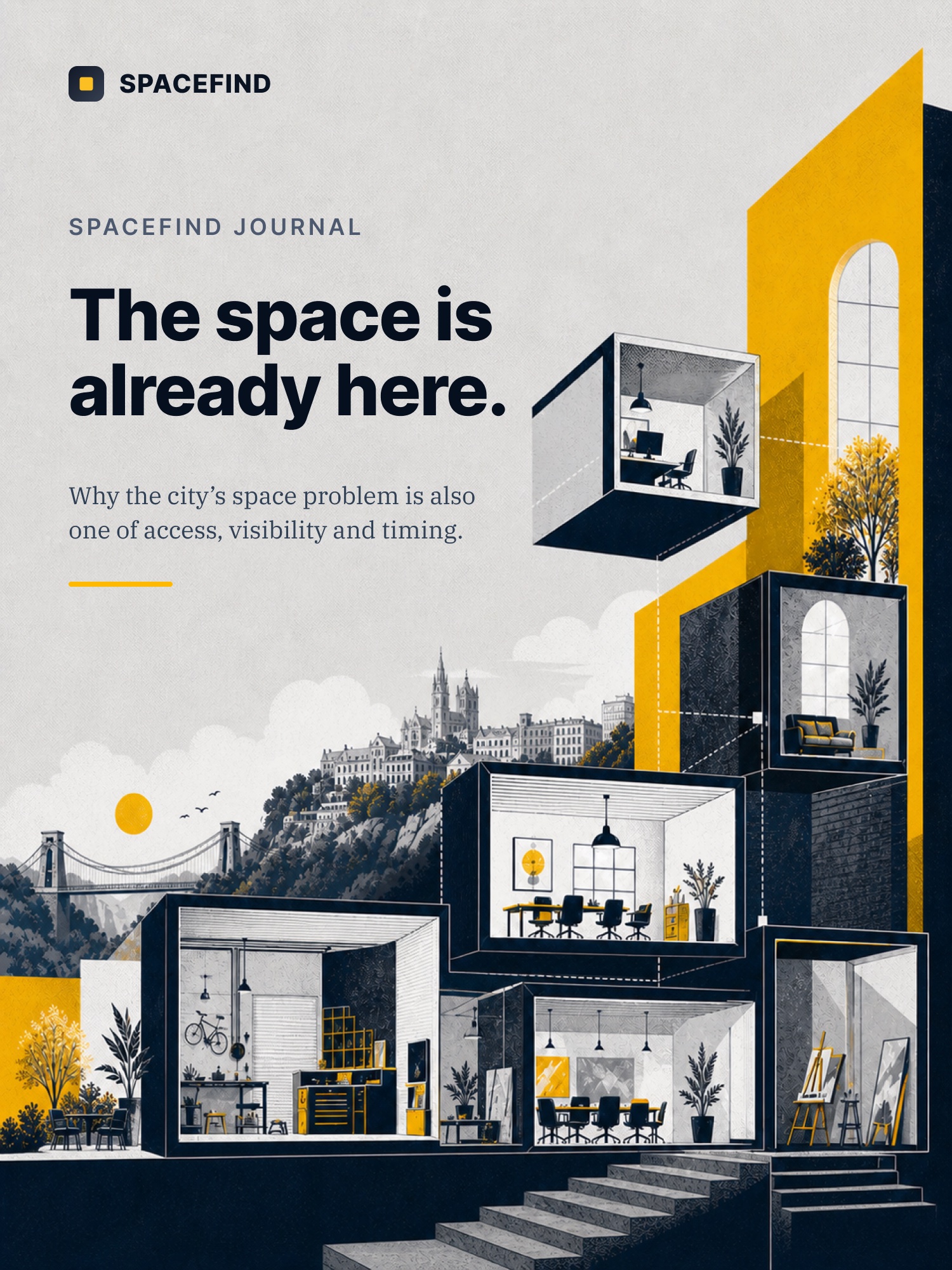
SpaceFind connects those looking for space with those who have space available. People can gain access to space for their space needs. Owners with a postcode can activate their space on SpaceFind and offer different ways to access it.
That wording is deliberately broad because the need for space is broad. The practical details should never be vague: each space still needs a clear purpose, accurate information and an honest route to access.
SpaceFind is currently growing across Bristol and surrounding area. The ambition is not to decide what every space should become. It is to make more of the city's possibilities visible—and let owners and users decide which of them make sense.
The next chapter of property will not be written only by constructing new buildings. It will also be written by seeing the ones around us differently.
The space is already here. What is missing is a better way in.